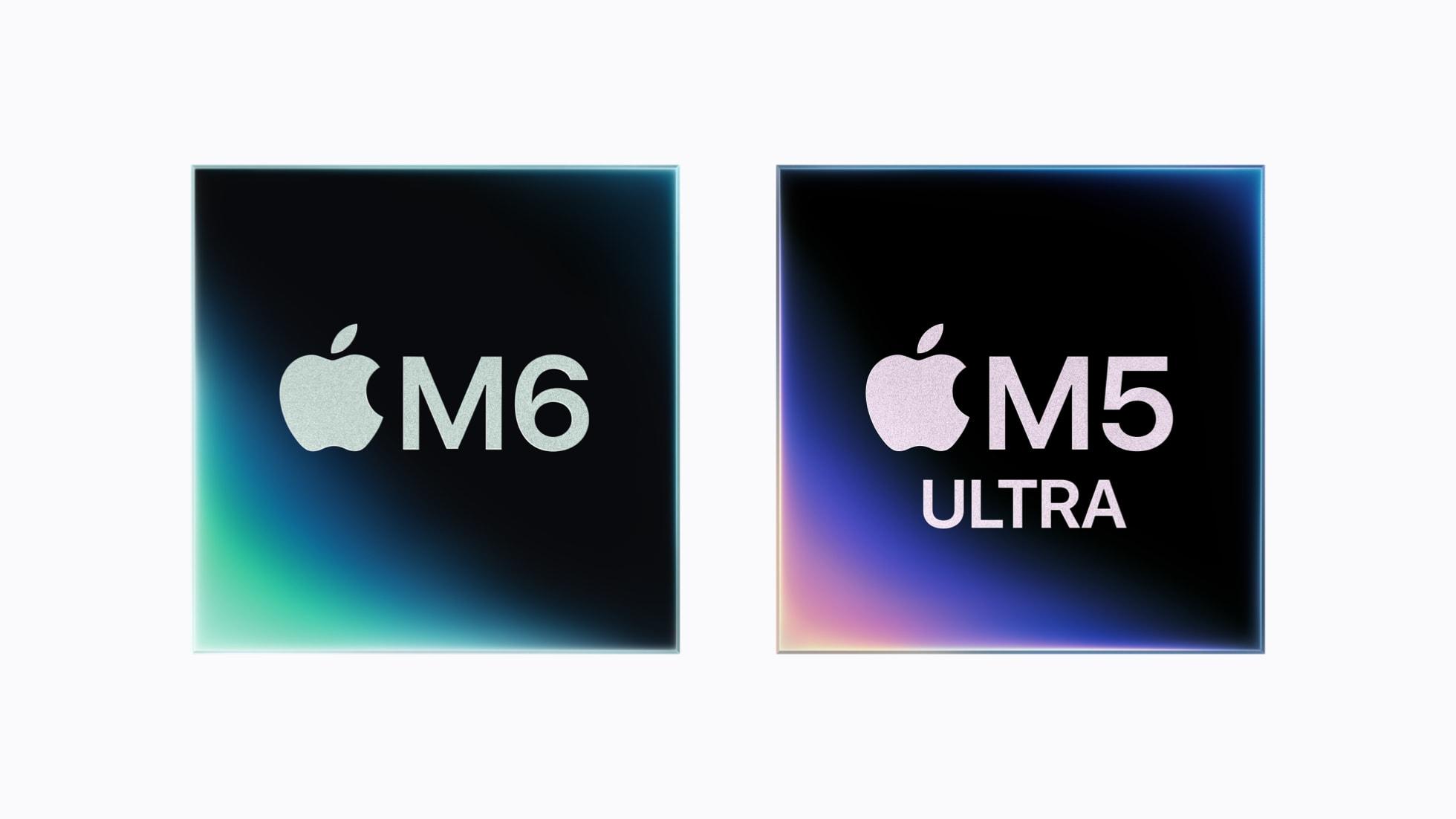
Apple has unveiled its next generation of silicon, introducing the M6 and M5 Ultra chips with major upgrades to processing power, graphics, memory bandwidth and artificial intelligence performance.
The company says the new processors will power the latest Mac mini and Mac Studio, with the M6 becoming Apple’s first chip built using a 2-nanometre process and the M5 Ultra introducing the company’s first quad-die architecture.
M6 Marks Apple’s Move to 2nm
At the centre of Apple’s announcement is the M6, a chip designed to deliver a significant increase in performance while maintaining the power efficiency that has become central to Apple silicon.
The M6 features a new 12-core CPU made up of two super cores, four performance cores and six efficiency cores. Apple says it delivers up to 1.2 times faster multithreaded performance than the M5 and as much as 2.4 times the performance of the original M1.
Apple is positioning the processor for a broad range of users, from students and everyday consumers to developers, enterprises and AI enthusiasts.
AI Takes Centre Stage
Artificial intelligence is a major focus of the new architecture.
The M6 introduces a Dual 16-core Neural Engine that Apple says provides up to twice the peak compute performance of previous generations. Applications can make use of both engines simultaneously to accelerate on-device AI workloads.
Its 12-core GPU also features a Neural Accelerator in every core, delivering what Apple says is nearly 30% more peak GPU compute for AI than the M5 and more than eight times that of the M1.
The M6 supports up to 32GB of unified memory and offers memory bandwidth of up to 170GB/s, allowing users to run large language models locally and perform AI tasks without necessarily sending workloads to the cloud.
M5 Ultra Targets High-End Professionals
While the M6 targets a wider range of Mac users, the M5 Ultra is Apple’s new heavyweight processor for demanding professional workloads.
Designed for applications including complex 3D rendering, visual effects, scientific analysis and frontier AI models, the M5 Ultra uses Apple’s UltraFusion technology to connect two dual-die M5 Max chips.
The result is Apple’s first quad-die silicon architecture, with inter-die bandwidth exceeding 4.4TB/s. The processor can be configured with up to a 36-core CPU consisting of 12 super cores and 24 performance cores.
Up to 80 GPU Cores and 512GB of Memory
The M5 Ultra’s specifications underline Apple’s growing ambitions in professional AI computing.
Its next-generation GPU can be configured with up to 80 cores, with a Neural Accelerator incorporated into each core. Apple claims the architecture delivers up to 4.5 times the peak GPU compute for AI compared with the M3 Ultra.
The chip also introduces second-generation Dynamic Caching and third-generation hardware-accelerated ray tracing, with Apple claiming graphics performance improvements of up to 40% compared with the M3 Ultra.
Perhaps more significantly for AI developers, M5 Ultra supports up to 512GB of unified memory and delivers up to 1.2TB/s of memory bandwidth.
According to Apple, that capacity makes it possible to keep massive datasets in local memory and run large language models containing hundreds of billions of parameters directly on the device.
Apple Wants More AI Workloads Running Locally
The new chips also form part of Apple’s broader push towards private, on-device artificial intelligence.
Developers can access their capabilities through frameworks and tools including Core AI, Core ML, Metal and Xcode. Apple says developers will be able to run and fine-tune large AI models locally while automatically optimising workloads across the CPU, GPU and Neural Engine.
“Today, we’re debuting the next giant leap in performance and AI compute for Apple silicon with the incredibly advanced M6 and the most powerful M-series chip yet, M5 Ultra,” said Sri Santhanam, Apple’s vice president of Silicon Engineering Group.
With M6 pushing Apple silicon into the 2nm era and M5 Ultra dramatically increasing the amount of computing power and memory available on a desktop Mac, Apple’s latest chips signal an increasingly clear strategy: make the Mac capable of handling sophisticated AI workloads locally, alongside the creative and professional applications for which its high-end machines are already known.