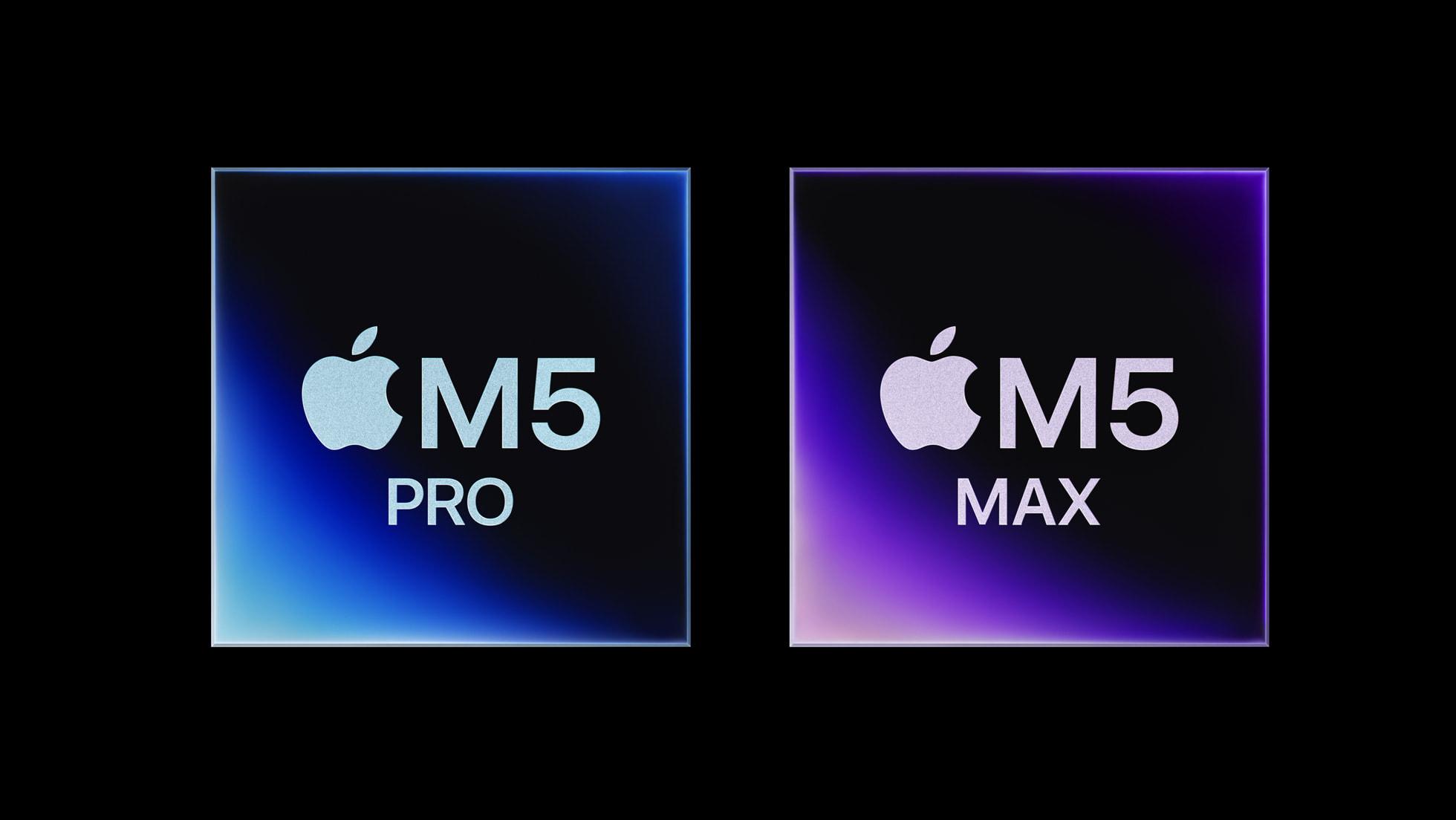
Apple has unveiled its latest high-performance silicon, the M5 Pro and M5 Max, designed to dramatically boost professional workflows on the new MacBook Pro. Built on Apple’s newly developed Fusion Architecture, the chips promise significant gains in CPU power, graphics performance, and on-device artificial intelligence capabilities.
The announcement signals Apple’s continued push to dominate the professional laptop market by delivering faster performance while maintaining the company’s hallmark energy efficiency.
A New Fusion Architecture for Apple Silicon
At the core of the new chips is Apple’s Fusion Architecture, a design that combines two third-generation 3-nanometer dies into a single system-on-a-chip (SoC). This packaging technology allows multiple components — including the CPU, GPU, Neural Engine, Media Engine, and memory controller — to operate together with high bandwidth and low latency.
The architecture also integrates Thunderbolt 5 support, enabling faster connectivity for high-performance accessories and external displays.
Johny Srouji, Apple’s senior vice president of Hardware Technologies, described the chips as a major step forward for the company’s custom silicon roadmap.
“M5 Pro and M5 Max are a monumental leap forward for Apple silicon, leveraging our new Fusion Architecture to scale the capabilities of Apple silicon while preserving performance, efficiency, and unified memory,” Srouji said.
New 18-Core CPU with “Super Cores”
Both chips feature a new 18-core CPU architecture made up of:
-
6 high-performance “super cores” designed for the fastest single-threaded performance
-
12 new performance cores optimized for efficient multithreaded workloads
According to Apple, this architecture delivers up to 30% faster performance for professional workloads, making it suitable for tasks such as complex data analysis, simulations, and software development.
Apple says the super cores include improvements like increased front-end bandwidth, enhanced branch prediction, and a new cache hierarchy.
Massive GPU and AI Improvements
The chips also introduce a next-generation GPU that scales up to 40 cores, each equipped with a Neural Accelerator for AI processing.
This combination delivers more than four times the peak GPU compute for AI tasks compared with the previous generation, enabling faster machine learning workflows, advanced graphics rendering, and improved visual effects.
The GPUs also support Apple’s third-generation ray-tracing engine, boosting performance by up to 35% in ray-traced applications compared with earlier chips.
M5 Pro: Built for Demanding Professional Workflows
The M5 Pro is designed for professionals such as data scientists, post-production audio engineers, and STEM students who require powerful processing and graphics performance.
Key features include:
-
Up to 18-core CPU
-
Up to 20-core GPU with Neural Accelerators
-
Up to 64GB unified memory
-
Memory bandwidth of up to 307GB/s
Apple says the chip offers over four times the peak GPU compute compared with M4 Pro, and more than six times the AI performance of the M1 Pro.
M5 Max: Designed for Extreme Compute Workloads
For even heavier tasks, Apple introduced the M5 Max, aimed at professionals such as 3D animators, AI researchers, and advanced app developers.
The chip features:
-
An 18-core CPU
-
Up to a 40-core GPU
-
Up to 128GB unified memory
-
Memory bandwidth of up to 614GB/s
This increased bandwidth allows faster processing of massive datasets, complex 3D scenes, and large-scale language models.
Apple says the M5 Max delivers more than four times the peak GPU compute compared with the previous generation, alongside significant improvements in graphics rendering and AI workloads.
Additional Technologies Built Into the Chips
Both chips include several additional technologies:
-
A 16-core Neural Engine to accelerate on-device AI features and Apple Intelligence
-
Apple’s latest Media Engine supporting H.264, HEVC, AV1 decoding, and ProRes encoding
-
Memory Integrity Enforcement, an always-on security feature designed to protect memory without affecting performance
-
Dedicated Thunderbolt 5 controllers integrated directly on the chip
Availability
The new chips power the latest MacBook Pro, which Apple says is its most powerful professional laptop to date.
Pre-orders opened shortly after the announcement, with devices scheduled to become available starting March 11, 2026.