A new report from Google and Ipsos shows that residents of South Africa are not only embracing artificial intelligence (AI), but increasingly using it as a practical tool for learning, work and major life decisions.
The study, “Our Life with AI: Helpfulness in the hands of more people”, shows people in South Africa are turning to AI to upskill, make career moves, and get everyday admin done – while staying optimistic about the technology’s potential to benefit education, the economy, and society.
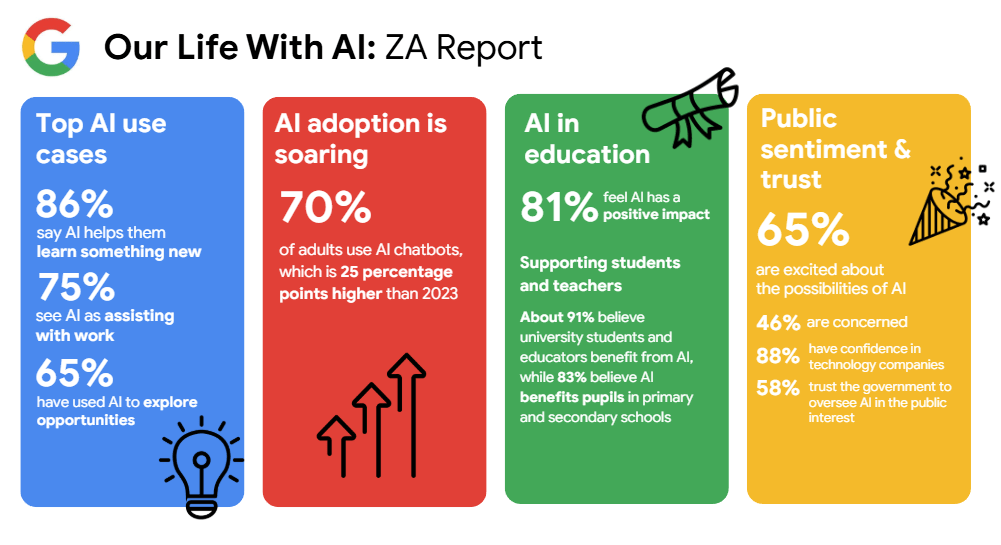
The survey shows that 70% of adults in South Africa have used an AI chatbot, which is 25 percentage points higher than 2023 and above the global average. At the same time, 90% say they are interested in learning more about AI, pointing to a country that wants to build AI literacy skills and confidence with new technology.
“South Africans are moving quickly from experimenting with AI to using it as an everyday tool to learn, work, and explore new opportunities,”
says Kabelo Makwane, Country Director for Google South Africa.
“This report shows that people in our country view AI as a driver of progress – from students and teachers to entrepreneurs and researchers. We’re committed to supporting people with the skills, products and safeguards they need so AI can be helpful and accessible for everyone.”
Key findings for South Africa
AI is levelling up learning and work: Local residents are engaging with AI at rates above the global average to deepen their knowledge and support their careers.
-
Learning with AI: 86% say AI helps them learn something new or understand a complex topic, compared to 74% globally.
-
A tool for work: 75% see AI as useful in the workplace, again ahead of global levels.
-
Everyday support: Over half (51%) have turned to AI for day-to-day help, from planning to problem solving.
-
The opportunity engine: 65% have used AI to explore a new business venture or career change, and 49% have used it to help navigate a major life event or decision.
-
Power users emerging: Nearly three in ten (27%) say they use AI “a lot” in their work or life, and 63% are open to doing more with AI but want to feel more confident in how to use it.
A big vote of confidence in AI for education
South African residents see AI as a strong positive for how people learn and access information.
-
Positive impact on learning: 81% believe AI is having a positive impact on the way we learn, compared with 65% globally.
-
Better access to information: 82% say AI is having a positive impact on how we access information.
-
Supporting students and teachers: The public believes primary and secondary students (85%), university students (91%), and educators (88%) are likely to benefit from AI, all above global averages.
-
Among people who already use AI for learning or schoolwork, 87% say AI is having a positive impact on the way we learn, with 67% calling it a major positive. Nearly two‑thirds (64%) believe AI will improve student outcomes.
As more people look for AI tools that support deeper understanding and accuracy rather than just quick answers, Google’s Guided Learning and AI Mode are designed to help people of all ages break down complex topics, check their understanding and turn knowledge into concrete, actionable plans.
Guided Learning in Gemini turns AI into a personal, step‑by‑step tutor that uses interactive check‑ins and tailored explanations to help people genuinely master each concept before moving on, while AI Mode in Search transforms the search bar into a deep‑dive research partner that pulls together information from across the web into clear, verifiable insights.
Together, these features respond directly to the public’s appetite for using AI to learn and upskill, moving beyond the “copy‑paste” era to help them build lasting knowledge and confidence.
Optimistic about an AI future
Experience with AI is strongly linked to excitement and optimism.
-
More excited than concerned: 65% say they are more excited about the possibilities of AI than concerned about the risks, compared with a global split of 53% excited and 46% concerned.
-
Excitement grows with usage: Among those who have used AI, 71% are more excited; among those who say they use AI “a lot” in their work or life, this rises to 84%.
-
Knowledge builds confidence: Among people who say they know “a lot” about AI, 82% are more excited and only 19% are more concerned.
Working together to unlock AI’s benefits
The public wants both technology companies and the government to help ensure AI benefits everyone.
-
Trust in tech companies: 63% believe AI companies are introducing AI responsibly, and 88% say they have confidence in technology companies to oversee AI in the public’s best interest.
-
Trust in government: 58% are confident that their government can oversee the development of AI in the public interest, on par with the global average.
-
Balancing innovation and protection: Users are split between prioritising protections for impacted industries through AI regulation (53%) and fostering advances in science, medicine, and other fields through AI innovation (47%).
-
Desire for the government to use AI: Most want to see the government using AI to unlock insights from complex data (67%), help citizens access public services (75%), and make systems more secure from cyber attacks (76%).
At the same time, the public remains clear‑eyed about challenges. Among those who think workers are unlikely to benefit from AI (18%), manufacturing workers, tradespeople and skilled labourers, and teachers are seen as most at risk, while healthcare and social service workers are seen as least likely to be negatively impacted.