Building AI Chips for the Physical World
South Korean semiconductor startup DEEPX is emerging as one of the companies to watch in the rapidly expanding AI-chip market, with a strategy focused on bringing artificial intelligence out of cloud data centres and directly into robots, vehicles, factories and other intelligent machines.
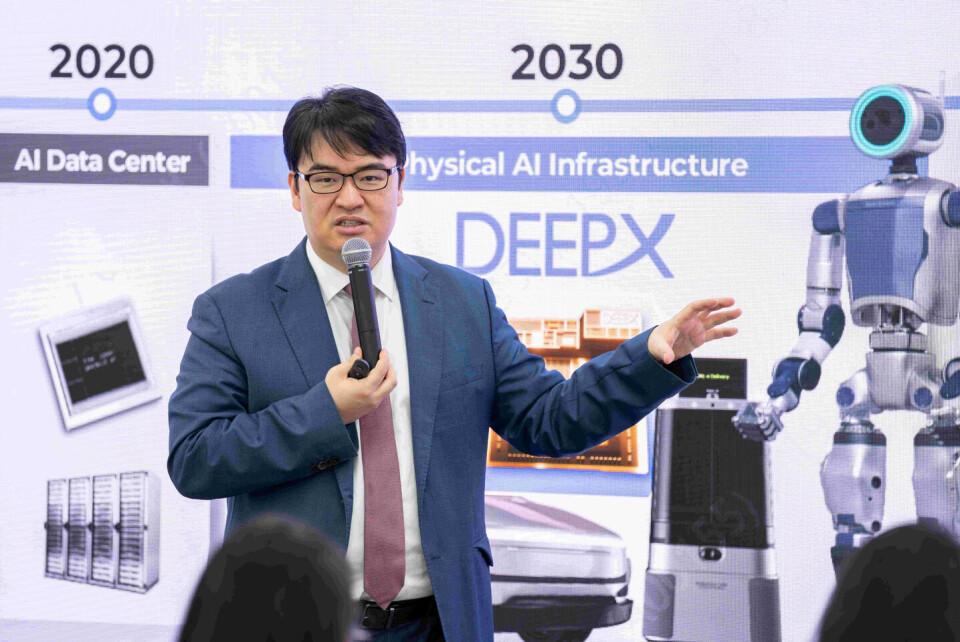
The company develops neural processing units (NPUs) designed for on-device AI, allowing machines to process AI workloads locally rather than constantly relying on remote servers. DEEPX says its broader vision is to become a foundational infrastructure company for what it calls “Physical AI.”
A Different Approach to AI Computing
While much of the AI boom has been driven by powerful data-centre GPUs, DEEPX is targeting situations where power consumption, latency and connectivity are critical.
Its chips are designed to enable AI inference directly on devices, potentially reducing the need to send large amounts of data to the cloud. This approach could be particularly important for robotics, autonomous systems, industrial automation, surveillance and smart-city applications.
The company has positioned energy efficiency as one of its key differentiators. DEEPX has said its current-generation technology can deliver significantly greater power efficiency than Nvidia’s Jetson Orin platform in certain applications.
DX-M1 Pushes AI Further Onto Devices
DEEPX’s DX-M1 is already being positioned for real-world edge-AI applications. In July 2026, the company announced that the processor can now run small language models (SLMs) fully on-device, expanding its capabilities beyond traditional computer-vision workloads.
That development reflects a broader shift in the AI industry: instead of every AI task being processed in a massive data centre, increasingly capable models are being designed to run locally on phones, industrial equipment, vehicles and robots.
DX-M2 Targets Generative AI
The company’s next-generation DX-M2 could take that strategy significantly further.
DEEPX unveiled its roadmap for the processor at CES 2026, saying it is being designed to run language models ranging from 20 billion to 100 billion parameters within a sub-5-watt power envelope.
The company is targeting applications where generative AI needs to operate directly inside physical machines rather than depending on a constant cloud connection.
DEEPX has also announced plans for the DX-M2 to enter mass production using Samsung Electronics’ 2-nanometre process technology, with volume production expected in 2027.
Hyundai Partnership Puts the Technology Into Robotics
One of the most significant validations of DEEPX’s technology is its relationship with Hyundai Motor Group.
The companies are expanding their collaboration to develop a generative-AI robotics platform using DEEPX’s next-generation chips. DEEPX’s existing technology is already being used in Hyundai’s four-wheeled delivery robots, while the next generation is intended to support more sophisticated AI capabilities.
The partnership is particularly significant as Hyundai accelerates its ambitions in robotics and humanoid machines. The automaker has outlined plans to manufacture up to 30,000 robots annually by 2028, creating a potentially substantial market for low-power AI computing.
From Startup to Potential Public Listing
DEEPX’s ambitions extend beyond chip development.
In April 2026, Reuters reported that the company was preparing for a potential South Korean IPO, with CEO Lokwon Kim saying the company was also open to a future US listing. DEEPX was simultaneously seeking more than 600 billion won, roughly $408 million at the time, in funding.
The fundraising and IPO plans underline the growing strategic importance of AI semiconductors as countries and companies compete to develop alternatives and complements to the dominant GPU-based AI infrastructure.
A Growing Physical AI Opportunity
DEEPX’s strategy arrives as AI increasingly moves beyond screens and software.
Robots need to see and understand their environments. Autonomous vehicles need real-time decision-making. Factories require machines capable of detecting objects, anomalies and production problems. Surveillance systems need to analyse video streams without necessarily sending everything to the cloud.
These applications require fast, low-power and increasingly autonomous computing — precisely the market DEEPX is targeting.
The company has also been expanding its global ecosystem. In June 2026, it announced a physical-AI mass-production partnership with AAEON, while it has separately partnered with companies including Ultralytics to advance AI deployment at the edge.
Why DEEPX Matters
The AI-chip race is no longer simply about building the fastest processor.
As AI becomes embedded in everyday machines, efficiency, cost, size, latency and the ability to operate without the cloud are becoming increasingly important.
DEEPX is betting that the next major AI computing market will therefore not exist only inside data centres. It will be distributed across factories, robots, vehicles, cameras and intelligent devices.