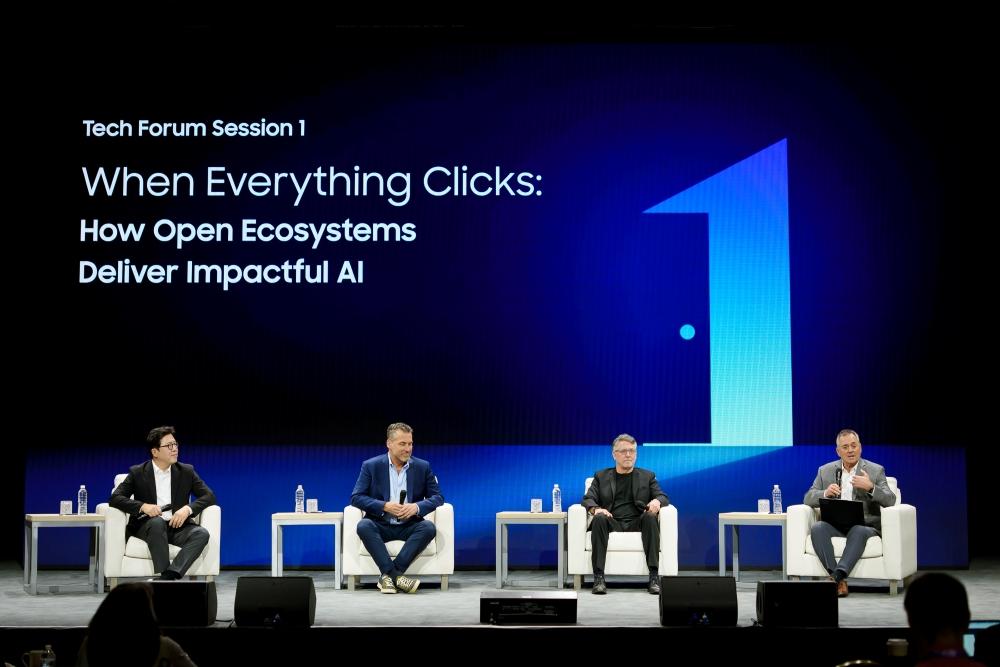
Samsung Electronics has placed smart home interoperability at the centre of the connected living conversation, convening cross-industry leaders at the first of its Tech Forum panels at CES 2026, held at The Wynn in Las Vegas.
The session, titled “When Everything Clicks: How Open Ecosystems Deliver Impactful AI,” explored how open collaboration across industries is reshaping connected homes into intelligent environments that feel seamless, safe and genuinely supportive of everyday life. Panelists agreed that as homes increasingly depend on devices and services from multiple brands, openness — rather than closed ecosystems — is essential to unlocking the true potential of home AI.
Openness as the foundation of home intelligence
Samsung used the platform to reinforce its belief that the next era of home intelligence must be built on interoperability. Open connectivity, the company argued, allows appliances, energy systems, safety services and digital partners to work together in ways that deliver real-world value — outcomes that siloed systems simply cannot achieve.
“Home is the most personal place in our lives, so home AI must earn trust — quietly, respectfully and with value users can feel,”
said Yoonho Choi, President and Chair of the Board of the Home Connectivity Alliance and Head of Strategic Alliances at Samsung Electronics.
“That requires interoperability across brands, so the home works as one system instead of disconnected features. Through cooperation with HCA and across industries, we’re turning openness into outcomes: safer homes, simpler routines and measurable savings — built on consent and transparency.”
Powering one of the world’s largest connected home ecosystems
Samsung also highlighted the scale of its connected living platform, noting that more than 500 million users are already part of the SmartThings ecosystem. With over a decade of experience in connected home technologies, the company positioned itself as a leader in the evolution from individual smart devices to system-wide, AI-driven intelligence.
This foundation, Samsung said, enables AI experiences that coordinate naturally across appliances and services, delivering benefits that feel intuitive rather than technical.
“It’s crucial to deliver tangible user benefits that make people’s lives better,”
said Michael Wolf, founder and editor-in-chief of The Spoon.
“There’s no area that will bring more benefit than a broadly connected kitchen — one that understands what’s in the refrigerator while connecting to water and heating networks, allowing for a more holistic system that can take preventative action.”
From collaboration to measurable consumer value
The discussion also focused on how open ecosystems can translate into measurable consumer benefits through cross-industry partnerships. Samsung pointed to its collaboration with Hartford Steam Boiler (HSB) as a practical example of responsible smart home data use creating tangible outcomes.
“We’re at a point where the connected home can bring seamless integration into user lifestyles, which begins to develop trust in smart home equipment,”
said Jed Usich, Senior Vice President of Strategic Growth Solutions at HSB.
“Through our partnership with Samsung, we’ve created a bridge to the insurance industry that takes simple datapoints and turns them into tangible savings for consumers.”
Designing AI that feels human, not intrusive
Beyond technology, panelists stressed that successful home AI must feel emotionally intelligent and blend naturally into daily routines — from cooking and relaxing to entertaining and caring for families. Thoughtful design, storytelling and behavioural understanding were highlighted as key to ensuring connected devices feel like calm, reliable companions rather than intrusive technologies.
As AI becomes more ambient and system-wide, the panel concluded that the future of home intelligence depends on interoperability, responsible data use and deep collaboration across industries.
Samsung closed the session by reaffirming its commitment to open ecosystems, positioning connected living not as a collection of smart features, but as a trusted, human-centred experience — proving that when everything truly clicks, home AI can meaningfully improve everyday life.