Apple Intelligence Unlocks On-Device AI for Developers
Apple has announced the rollout of its Foundation Models framework alongside the release of iOS 26, iPadOS 26, and macOS 26, enabling developers to embed powerful, privacy-preserving AI features directly into their apps. At the core of this update is Apple’s on-device large language model, which supports intelligent features that work offline and at no additional cost to users.
Susan Prescott, Apple’s vice president of Worldwide Developer Relations, said:
“The in-app experiences developers are creating are expansive and creative, showing just how much opportunity the Foundation Models framework opens up. From generating journaling prompts that spark creativity in Stoic, to conversational explanations of scientific terms in CellWalk, it’s incredible to see the powerful new capabilities already enhancing everyday apps.”
Transforming Health and Fitness
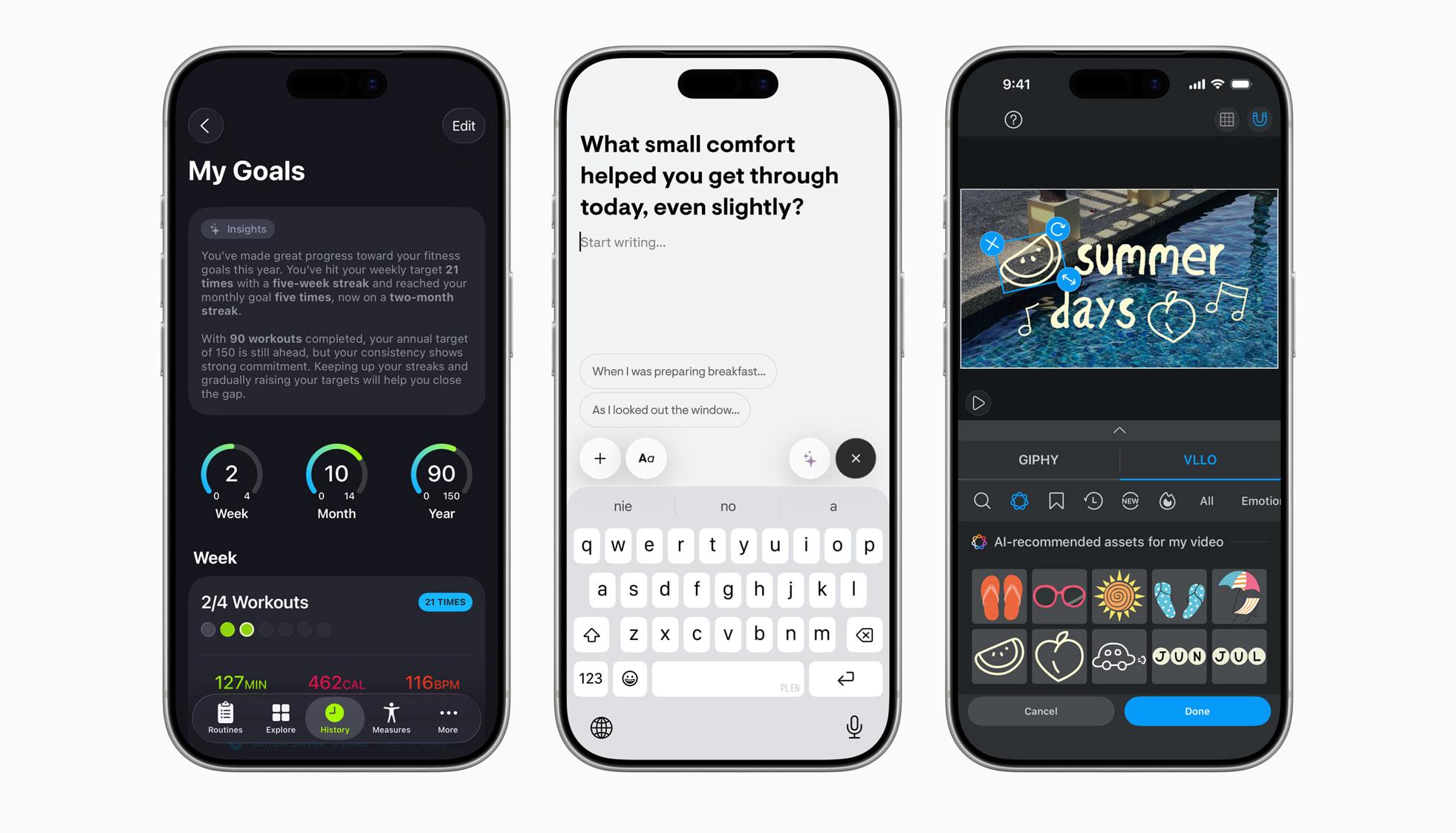
SmartGym has integrated the framework to help users design workouts, track performance, and receive adaptive coaching feedback. The app now generates detailed summaries, personalized recommendations, and motivational notes — all processed on device.
Other fitness apps also leveraging the framework include:
-
SwingVision — provides video-based tennis and pickleball performance feedback.
-
7 Minute Workout — creates personalized routines while avoiding injury risks.
-
Gratitude — delivers weekly reflective summaries and affirmations.
-
Wakeout! — generates customized movement breaks with context-based explanations.
Enhancing Emotional Well-Being and Journaling
The journaling app Stoic now delivers mood-sensitive prompts, reflective notifications, and contextual search features. All prompts and insights are generated entirely on device, ensuring that personal entries remain private.
“Prompts and reflections now adapt to a user’s state of mind, so the experience feels personal and evolves day by day,” said Stoic founder Maciej Lobodzinski.
Revolutionizing Education
Educational apps are using the framework to make learning more interactive and adaptive.
-
CellWalk transforms molecular biology visuals into conversational explanations tailored to a learner’s knowledge level.
-
Grammo introduces a conversational AI tutor for English grammar exercises.
-
Lil Artist lets children co-create illustrated stories through guided prompts.
-
Vocabulary categorizes saved words into personalized learning themes.
-
Platzi integrates AI-powered Q&A for lesson-specific explanations.
Boosting Creativity and Productivity
Productivity apps are also reimagining workflows:
-
Stuff uses natural language understanding to convert written, spoken, or handwritten notes into organized tasks.
-
VLLO leverages both Foundation Models and Vision frameworks to recommend music and effects during video editing.
-
Signeasy, Agenda, and OmniFocus 4 have introduced AI-powered assistants to summarize, organize, and suggest next steps for documents and projects.
-
Essayist turns PDFs into structured references and citations with a simple drag-and-drop.
Developer Access and Global Rollout
The Foundation Models framework is integrated with Swift for easy implementation and supports guided generation to deliver consistent, reliable outputs. Developers can connect the model with app-specific tools to ensure context-aware responses.
Currently available in beta, Apple Intelligence supports nine languages including English, French, German, Italian, Portuguese (Brazil), Spanish, Simplified Chinese, Japanese, and Korean.
For system requirements and feature availability, Apple directs users to support.apple.com/en-us/121115.